
Diagnosing the Dev / Maintenance Mode Mismatch
Self-assessment! Find where you’re paying development prices for maintenance work and how to fix it

Last week I wrote about a core idea I think will shape the age of automation: the development vs maintenance modes. Dev is short, intense and human-heavy; maintenance is long and boringly automated. But knowing that the mismatch exists is only the first step. The harder work is diagnosing exactly where it occurs.
The Development—Maintenance Cycle
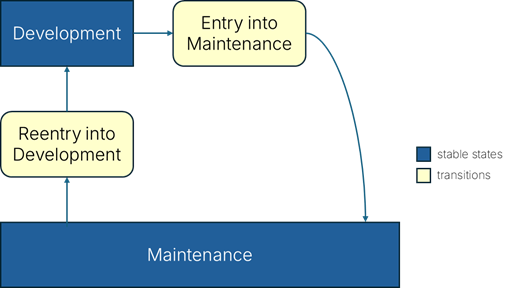
For each product or business unit you’re responsible for, read across each row and circle the stage that best matches reality. Your “true stage” is the one you mark most often.
Mismatches
Once you’ve identified your true stage, look for mismatches:
Stage-3 economics + Stage-1 automation → You’re running a profitable asset manually. Launch an automation sprint
Stage-3 economics + Stage-1 talent → You’re funding a permanent dev org where you should rent bursts
Stage-1 goal + Stage-3 automation → You’re still validating core assumptions, but already automated heavily. You’re optimizing a product that might be the wrong product. Pause the pipelines and get back to learning
Choosing the Right Lever
In Stage 2, ramp automation from ad-hoc helpers to production-grade systems by implementing observability, pipelines, self-healing. Define clear service boundaries: interfaces, SLAs, cost models. You’re moving the construction crew from the construction site.
In Stage 3, treat manual work as technical debt. Your target should be a thin human layer on top of automated orchestrators and robust infra. Rent capabilities for short development bursts rather than maintaining a permanent team. Development-mode people trapped in maintenance because “they know the system” will invent unnecessary work, leave or degrade quality.
Stage 4 means deliberately reentering build mode. Keep the old automation stack running while building the new one. Rented development shines again! You don’t need a giant permanent team for a 6-month burst.